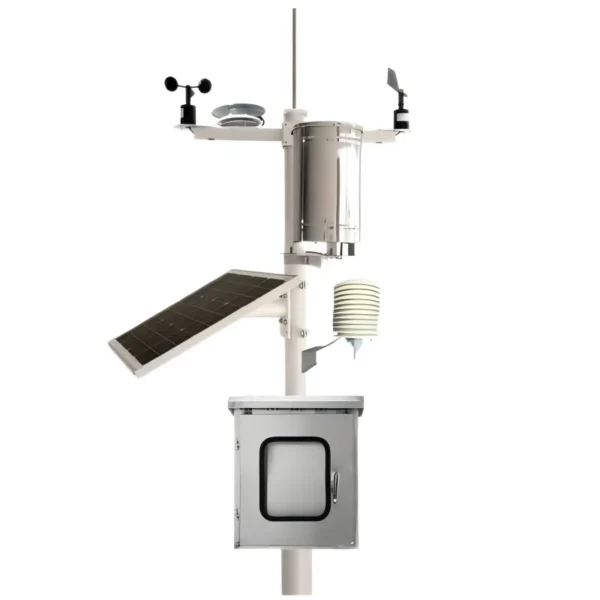
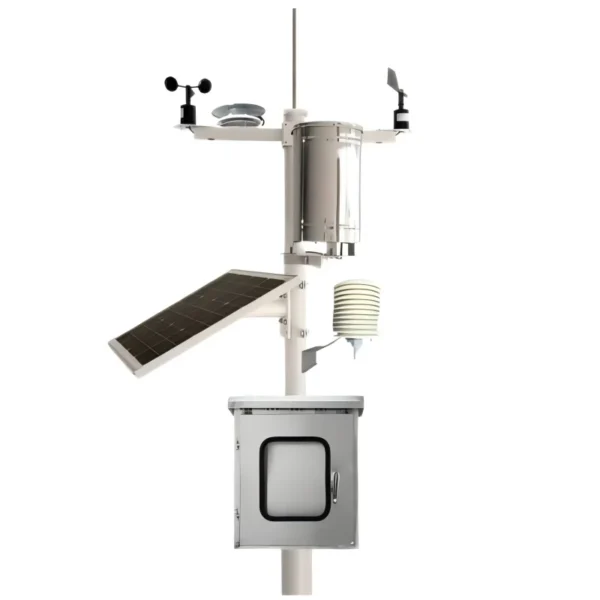
# Automatic Weather Station: Definition and Functionality
An Automatic Weather Station (AWS) is a sophisticated system designed to collect and record meteorological data without the need for constant human intervention. These stations are equipped with various sensors that measure environmental parameters such as temperature, humidity, wind speed, wind direction, rainfall, and atmospheric pressure. The data collected by an AWS is crucial for weather forecasting, climate research, and various applications in agriculture, aviation, and disaster management.
## Components of an Automatic Weather Station
An AWS typically consists of several key components:
– Sensors: These are the primary tools for measuring weather parameters. Common sensors include thermometers for temperature, hygrometers for humidity, anemometers for wind speed, wind vanes for wind direction, rain gauges for precipitation, and barometers for atmospheric pressure.
– Data Logger: This device records the data collected by the sensors. It stores the information in a digital format, which can be accessed and analyzed later.
– Power Supply: AWS systems are often powered by solar panels or batteries, ensuring continuous operation even in remote locations.
– Communication System: Many AWS units are equipped with wireless communication capabilities, allowing them to transmit data to a central server or directly to users via the internet or satellite.
## Functionality of an Automatic Weather Station
The primary function of an AWS is to provide accurate and timely weather data. Here’s how it works:
– Data Collection: Sensors continuously monitor environmental conditions and collect data at regular intervals.
– Data Storage: The data logger stores the collected information, often with timestamps for each measurement.
– Data Transmission: In many cases, the data is transmitted to a central database or directly to users. This can be done via wired connections, wireless networks, or satellite links.
– Data Analysis: The collected data is analyzed to generate weather forecasts, monitor climate trends, and support decision-making in various fields.
## Applications of Automatic Weather Stations
AWS systems are used in a wide range of applications:
– Weather Forecasting: Meteorologists use data from AWS to predict weather patterns and issue forecasts.
– Agriculture: Farmers rely on AWS data to make informed decisions about planting, irrigation, and harvesting.
– Aviation: Airports use AWS to monitor weather conditions and ensure safe takeoffs and landings.
– Disaster Management: AWS data helps in predicting and responding to natural disasters such as hurricanes, floods, and droughts.
## Conclusion
Automatic Weather Stations play a vital role in modern meteorology and environmental monitoring. By providing accurate and real-time data, they help us understand and predict weather patterns, support agricultural practices, ensure aviation safety, and manage natural disasters effectively. As technology advances, AWS systems are becoming more sophisticated, offering even greater precision and reliability in weather data collection.
Keyword: what is automatic weather station