
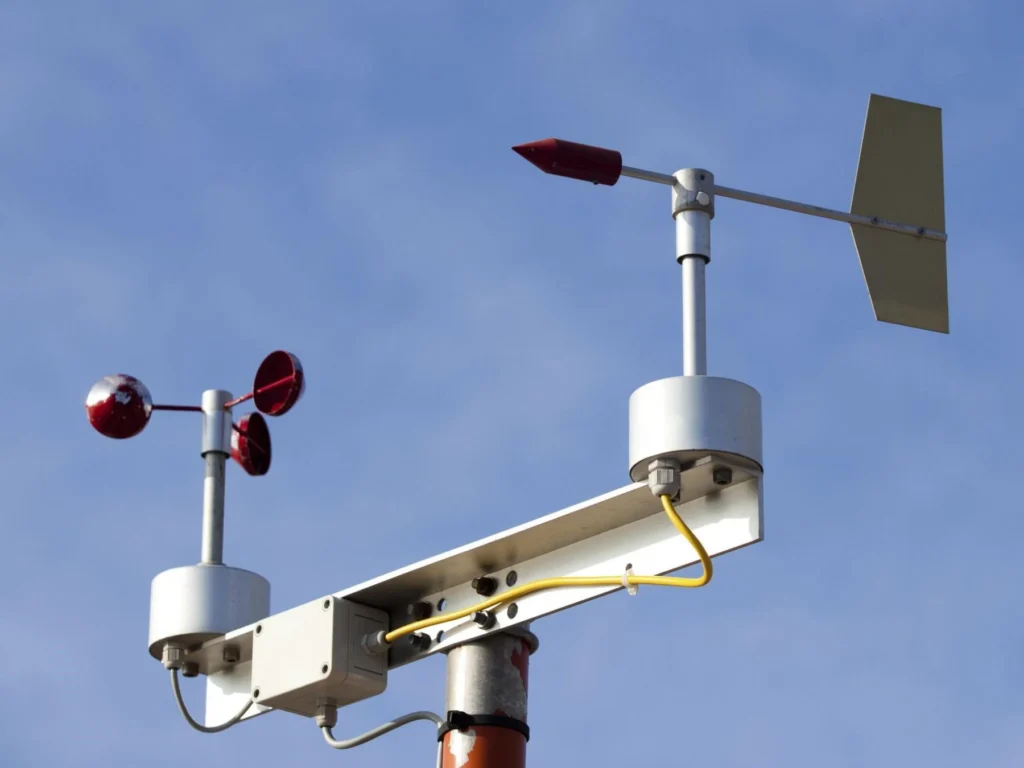
# Anemometer: The Instrument for Measuring Wind Speed
Wind speed is a crucial parameter in various fields, including meteorology, aviation, and environmental studies. To accurately measure this parameter, scientists and engineers rely on a specialized instrument known as an anemometer.
## What is an Anemometer?
An anemometer is a device designed to measure the speed of wind. It is an essential tool for weather stations, as it provides critical data for weather forecasting and climate studies. The term “anemometer” is derived from the Greek word “anemos,” meaning wind, and “metron,” meaning measure.
## Types of Anemometers
There are several types of anemometers, each with its unique mechanism for measuring wind speed:
– Cup Anemometer: This is the most common type, consisting of three or four cups mounted on horizontal arms. The cups catch the wind, causing the arms to rotate. The speed of rotation is proportional to the wind speed.
– Vane Anemometer: Also known as a windmill anemometer, this type uses a propeller mounted on a wind vane. The vane aligns itself with the wind direction, and the propeller’s rotation speed indicates the wind speed.
– Hot-Wire Anemometer: This type uses a thin wire heated to a constant temperature. The wind cools the wire, and the amount of cooling is used to calculate the wind speed.
– Ultrasonic Anemometer: This advanced type uses ultrasonic sound waves to measure wind speed and direction. It is highly accurate and is often used in research and high-precision applications.
## How Does an Anemometer Work?
The working principle of an anemometer depends on its type. For instance, in a cup anemometer, the wind causes the cups to rotate. The rotation speed is measured and converted into wind speed using a calibration curve. Similarly, in a hot-wire anemometer, the cooling effect of the wind on the heated wire is measured and used to determine the wind speed.
## Applications of Anemometers
Anemometers are used in a wide range of applications:
– Weather Forecasting: Anemometers provide essential data for predicting weather patterns and issuing weather warnings.
– Aviation: Pilots use anemometers to assess wind conditions before takeoff and landing, ensuring safe flights.
– Environmental Monitoring: Anemometers help monitor wind patterns in environmental studies, such as assessing the impact of wind on ecosystems.
– Wind Energy: In the renewable energy sector, anemometers are used to measure wind speed at potential wind farm sites, helping to determine the feasibility of wind energy projects.
## Conclusion
The anemometer is an indispensable tool for measuring wind speed, playing a vital role in various scientific and practical applications. Whether it’s for weather forecasting, aviation safety, or environmental monitoring, the accurate measurement of wind speed provided by anemometers is crucial for making informed decisions and ensuring safety. As technology advances, we can expect even more sophisticated and accurate anemometers to be developed, further enhancing our ability to understand and harness the power of the wind.
Keyword: instrument to measure wind speed